

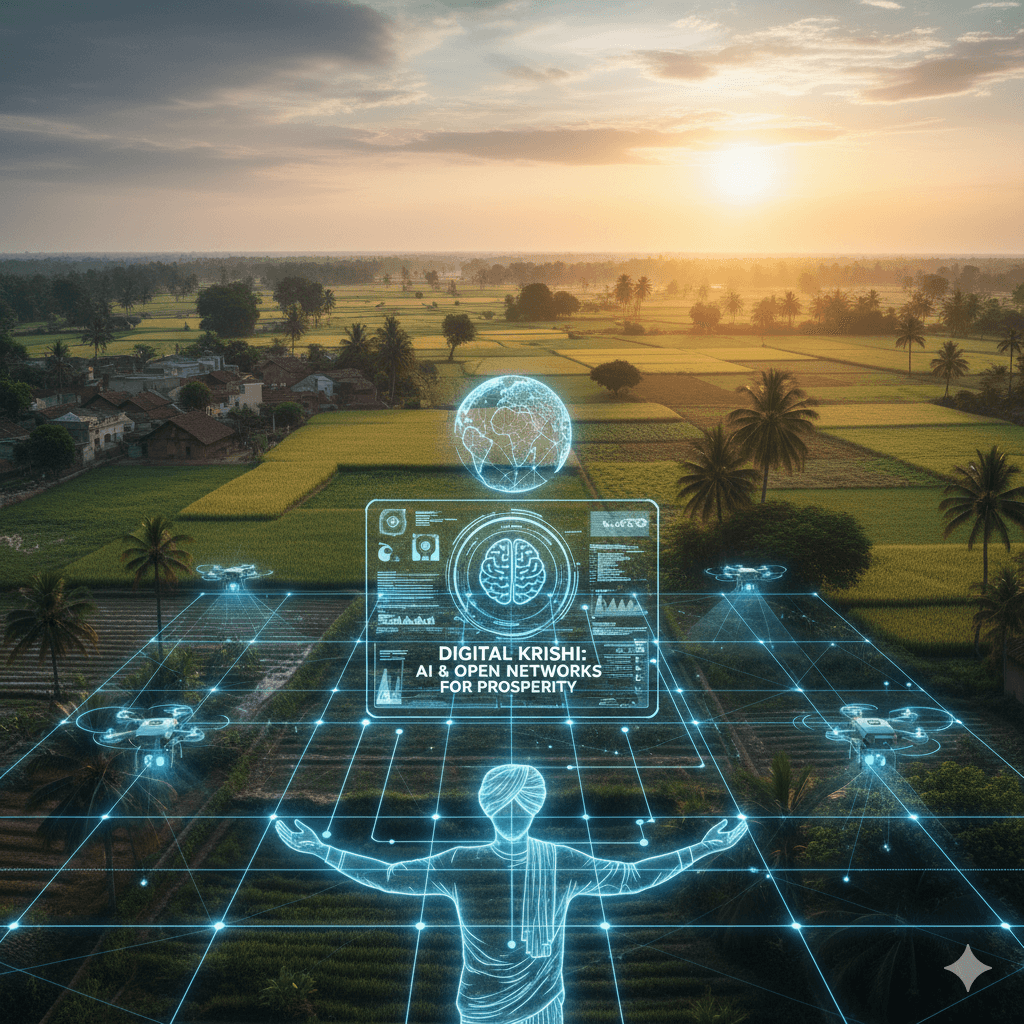
Earning ₹1,00,000+ versus less than ₹50,000.
It could have been a 50% difference - a profitable harvest vs. slightly more than covering the expenses for Ravi Patil, a potato farmer in Maharashtra. The choice? Sell his 8000kg harvest immediately in July, or store it in a godown for better prices later.
For the Indian economy, agriculture has always been one of the most important sectors, employing a significant part of the workforce. Yet farmers like Ravi have historically made critical post-harvest decisions based on gut feeling, neighbour advice, or the previous year's patterns. What they lacked was access to the sophisticated market intelligence that large agribusinesses use to maximize profits.
This is how AI powered by open networks could change that equation—not by replacing farmer judgment, but by democratizing access to market intelligence that was previously available only to big players.
The Traditional Dilemma Every Farmer Faces
Ravi stood in his potato field in July, facing a decision that would determine whether his family prospered or struggled for the next six months. His 8000kg potato harvest was ready, and the local market was offering around ₹1,400 per quintal.
"Store it and get better prices in a few months," advised his neighbour, echoing conventional wisdom. After all, potato prices typically rise during the off-season when supply decreases.
However, there were several challenges with this traditional approach:
- Storage costs were coming to around ₹25,000 for the season
- No reliable way to predict actual future prices
- Risk of spoilage eating into profits
- Opportunity cost of delayed payment
What Ravi needed was what every major agricultural corporation has: real-time market analysis, price prediction models, and comprehensive cost-benefit calculations.
Enter the Extension Officer's New Toolkit
This is where Suresh Jadhav, the local agricultural extension officer, stepped in with something revolutionary—an AI-powered agricultural decision support system connected to an open network powered by Beckn protocol that provided access to market data across the agricultural ecosystem.
"Let me check what the network can tell us," Suresh said, pulling up the system on his tablet. The AI began its work through a series of orchestrated queries:
Step 1: Understanding the Farmer's Situation The system first extracted key details from their conversation—8000kg potato harvest, the farmer's location, immediate sale vs storage decision. This context would guide all subsequent analysis.
Step 2: Market Price Discovery The AI queried the Beckn network for potato prices across multiple mandis (wholesale markets):
- Pune APMC: ₹1,404/quintal
- Mumbai APMC: ₹1,425/quintal
- Nashik APMC: ₹1,390/quintal
- Kolhapur APMC: ₹1,450/quintal
- Aurangabad APMC: ₹1,376/quintal
Step 3: Transportation Cost Calculation For each market, the system calculated transport costs from the farm:
- Distance calculations using route data
- Fuel costs based on current rates
- Handling charges for 80 quintals
- Vehicle type recommendations (LCV for this quantity)
Step 4: Storage Facility Query The AI accessed storage operator data through the network:
- Available godown capacity in the region
- Season storage rates (Around ₹25,000 for 80 quintals)
- Facility locations and quality ratings
Step 5: Price Prediction Modeling Using historical data and seasonal patterns, the system predicted:
- 3-month future price: ₹1,500/quintal
- 6-month future price: ₹1,300/quintal
- Confidence levels and risk factors
Step 6: Comprehensive Profit Analysis Finally, the AI synthesized all this data to calculate net profits for each option, accounting for transport costs, charges, storage costs, and opportunity costs.
Within minutes, what would have taken days of calling mandis, transport operators, and storage facilities was complete. However, the system's accuracy depended entirely on the quality and completeness of data available through the network. In areas with limited network participation or poor data reporting, the recommendations could be less reliable.
The AI Analysis That Changed Everything
This is what the system revealed:
Option 1: Immediate Sale
- Market Price: ₹1,400/quintal at Pune APMC
- Gross Revenue: ₹1,12,000 (80 quintals × ₹1,400)
- Transport & Handling Cost: ₹8,000
- Mandi Charges: ₹2,240 (~2% commission)
- Net Profit: ₹1,01,760
Option 2: 3 Month Storage
- Predicted Price: ₹1,500/quintal (October 2025)
- Gross Revenue: ₹1,20,000
- Storage Cost: ₹25,000
- Transport & Handling Cost: ₹8,000
- Mandi Charges: ₹2,400 (~2% commission)
- Net Profit: ₹84,600
Option 3: 6 Month Storage
- Predicted Price: ₹1,300/quintal (January 2026)
- Gross Revenue: ₹1,04,000
- Storage Cost: ₹50,000
- Transport & Handling Cost: ₹8,000
- Mandi Charges: ₹2,080 (~2% commission)
- Net Profit: ₹43,920
The numbers were stark. Despite conventional wisdom suggesting storage would yield better prices, the AI analysis revealed that high storage costs might wipe out any price gains!
The Technology Behind the Transformation
What made this level of analysis possible was the combination of artificial intelligence with open network protocols that democratized data access.
The system operates on a Beckn-powered open network connecting various participants in the agricultural ecosystem:
- Mandis and APMCs sharing market price data
- Storage facility operators publishing availability and rates
- Transportation providers offering route costs and capacity
- Government agencies contributing weather and policy data
Built on top of this open network is an AI system using Model Context Protocol (MCP) that:
- Synthesizes data from multiple network participants
- Maintains context about individual farmer situations and preferences
- Provides personalized analysis based on specific crop quantities, locations, and risk profiles
The MCP architecture allows the AI to maintain persistent memory of farmer interactions while securely accessing data from the network.
Building Trust in Data-Driven Decisions
Suresh explained how the AI wasn't replacing traditional knowledge but enhancing it with data from an open network that connected mandis, storage facilities, and transport providers across the region.
"This is the same type of analysis that big trading companies use," Suresh explained. "The only difference is now the data flows through an open network that gives you equal access."
Suresh was also careful to explain the system's limitations: "The predictions are based on current network data and historical patterns. If there's a sudden policy change or unexpected weather event, the actual outcomes might differ."
After consulting with two other progressive farmers in his village who had used similar analysis for their onion crops, Ravi decided to trust the data.
The Decision and Its Impact
Ravi chose to sell immediately. In August, he transported his 8000kg potato harvest to Pune APMC and sold it for what the AI had predicted: ₹1,400 per quintal, earning over ₹1,00,000 for his produce.
Three months later, when storage facility operators were still charging ₹25,000 per month and potato prices had risen to ₹1,500 per quintal as predicted, Ravi calculated what he would have earned: ₹84,600. The difference is almost equivalent to the input costs that Ravi might have spent on growing his potato.
Six months later, the vindication was even more dramatic. January prices dropped to ₹1,300 per quintal due to market saturation from stored harvests. Had Ravi followed traditional advice and stored for the "best" prices, he would have made less than half of what he made by selling rightaway!
Democratizing Agricultural Intelligence Through Open Networks
What's remarkable about this transformation isn't the technology itself—it's the democratization of market intelligence through open networks. For decades, large agribusinesses have used sophisticated analytics to optimize their buying, selling, and storage decisions. They've had teams of analysts, access to real-time market data, and predictive models.
Small farmers like Ravi had none of this. They made critical financial decisions with partial information, often following patterns that worked in previous decades but might not apply to today's volatile markets.
The combination of AI and open network protocols doesn't replace farmer judgment—it enhances it with the same quality of information that big players have always used. The open network aspect is crucial: unlike proprietary systems that create new information silos, Beckn-powered networks ensure that data access is democratized.
The Broader Transformation
This transformation requires:
- Ecosystem participation: Mandis, storage facilities, and transport providers must actively contribute to open networks
- Data standardization: Common protocols for sharing agricultural market data
- Infrastructure investment: Reliable internet connectivity in rural areas
- Capacity building: Training extension officers to interpret and explain AI insights
If implemented at scale across Maharashtra's 43,000 villages, and if even 10% of the state's farmers gain access to reliable market intelligence through open networks, the collective income increase could be significant !
From Imagination to Reality
Sure enough, by now you've likely realized that this is an illustrative scenario—but the technology and data already exist today. Open Networks are operational across multiple sectors including Agriculture in India, AI systems with MCP are being deployed for complex decision-making, and agricultural data from mandis, storage facilities, and transport networks is increasingly digitized.
The components for this agricultural transformation are available right now. What's needed is the vision to connect them through open networks that democratize access to market intelligence. Ravi's story isn't happening yet—but it could be, tomorrow.


