
At Tekdi, our core purpose is to catalyze societal transformation by empowering organizations with technology. But it is hard to focus on transformation when you are stuck in a loop of repetitive data entry.
Recently, while implementing a Building Permits module for an African nation, we hit a roadblock that threatened to stifle our innovation. The project required full localization between English and French to ensure a seamless experience for native speakers.
The specific version of the DIGIT framework we were using didn't support text label localization for workflows out of the box. We were left with a manual grind: editing JSON payloads one by one, hitting APIs twice, and praying there were no typos.
This wasn't just a productivity issue; it was a culture issue. One of our core values is Enjoying the Magic of Creation. There is no magic in copy-pasting JSON for 12 hours a week.
Here is how we applied the Tekdi Way—specifically, our Product First mindset—to turn this manual nightmare into a reusable asset.
The Challenge: Stuck at the Base of the Pyramid ⏳
If you visualize software as a pyramid, the base consists of foundational blocks, while the apex holds the unique innovations. We found ourselves stuck fixing the base rather than building the apex.
For 9 different permits, we had to localize hundreds of unique labels.
- The Process: Identify the label, translate, format JSON, and manually trigger APIs for en_IN and fr_FR_IN .
- The Cost: 3–4 minutes per label. With 175–200 labels a week, we were burning nearly 2 days of developer time.
This friction wasn't just slowing us down; it was preventing us from delivering the "unique differentiators" that the client actually valued.
The Solution: A "Product First" Approach 🤖
At Tekdi, we believe in Sustainable Open Source—the idea that when you improve a foundational block, you should do it in a way that reduces the burden for everyone.
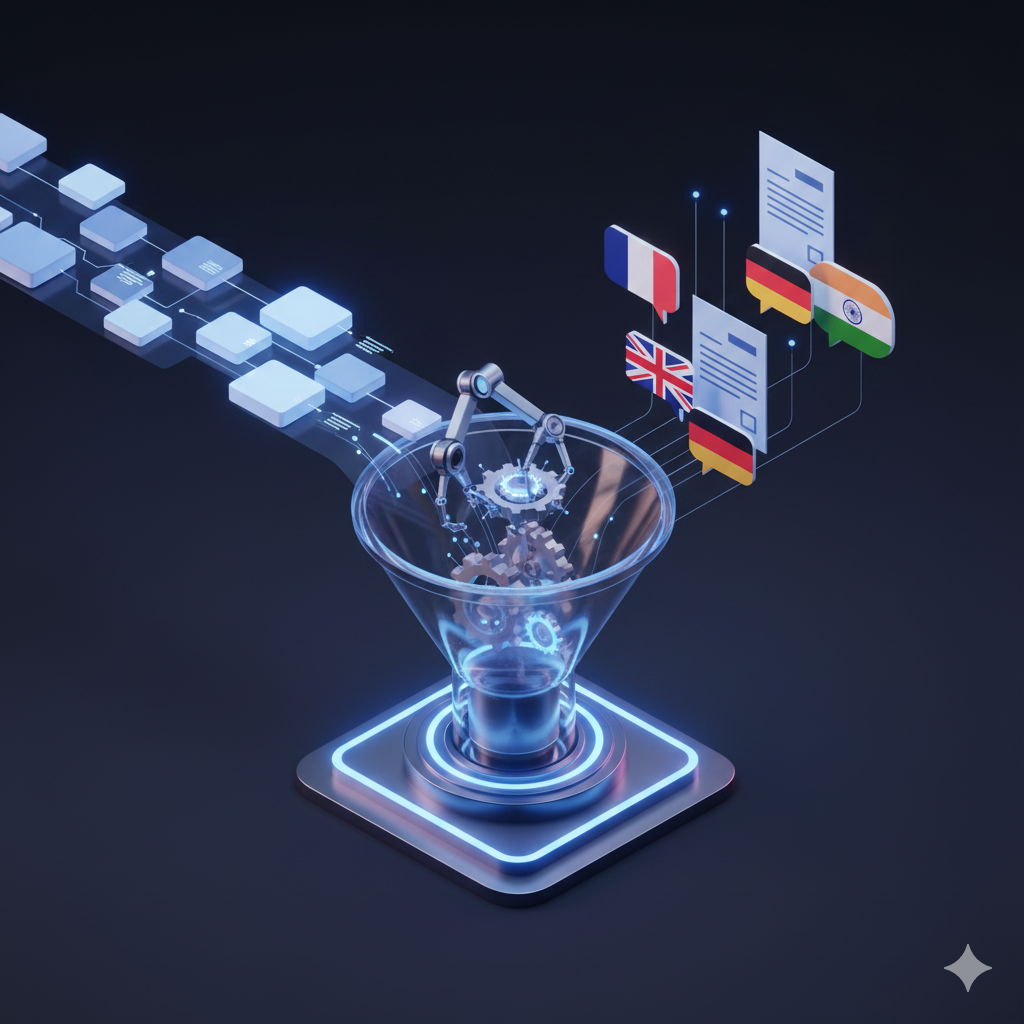
Instead of just "hacking" a fix for this one project, we decided to build a tool. I teamed up with AI assistants to co-pilot the logic and built a custom React-based automation script that interacts directly with the DIGIT APIs.
The New Workflow:
- Prepare: We add labels and translations to a Master CSV.
- Execute: The script reads the CSV and automatically hits the DIGIT APIs for both languages.
- Verify: A success report is generated instantly.
The Result:
A label update that took 4 minutes now takes ~2 seconds.
The Impact: Empowering the "Sarkar" and "Bazaar" 🚀
The efficiency gains were massive—9 to 12 hours saved per week. But the true success lay in how this aligned with our mission to empower organizations.
From Vendor Reliance to Client Autonomy Because we built this tool with a product mindset (intuitive, CSV-based), we were eventually able to hand it over to the client's team.
Instead of relying on us for every typo fix, they now control their own content. We empowered the "Sarkar" (Government) to move with the speed of the "Bazaar" (Business).
Giving Back: Building For Most, Not For Few 🌍
A key tenet of the Tekdi Way is to Build for most, not for few.
While this project focused on English and French, we designed the automation to be language-agnostic. Whether the next DIGIT adopter needs German, Spanish, or Hindi, this tool works without rewriting code.
By open-sourcing this script, we are Giving Back to the community. We are improving the foundational blocks of DIGIT so that future teams can skip the grunt work and go straight to the Magic of Creation.
🔗 https://github.com/tekdi/djibouti-egov-mdms-data/tree/djibouti-3/tools
Reflection:
The first time we ran the script and saw 200 labels process successfully while we sipped our hot coffee, realisation struck that we hadn't just saved time. We had unlocked the capacity to Give Our Best to the problems that actually matter.


