

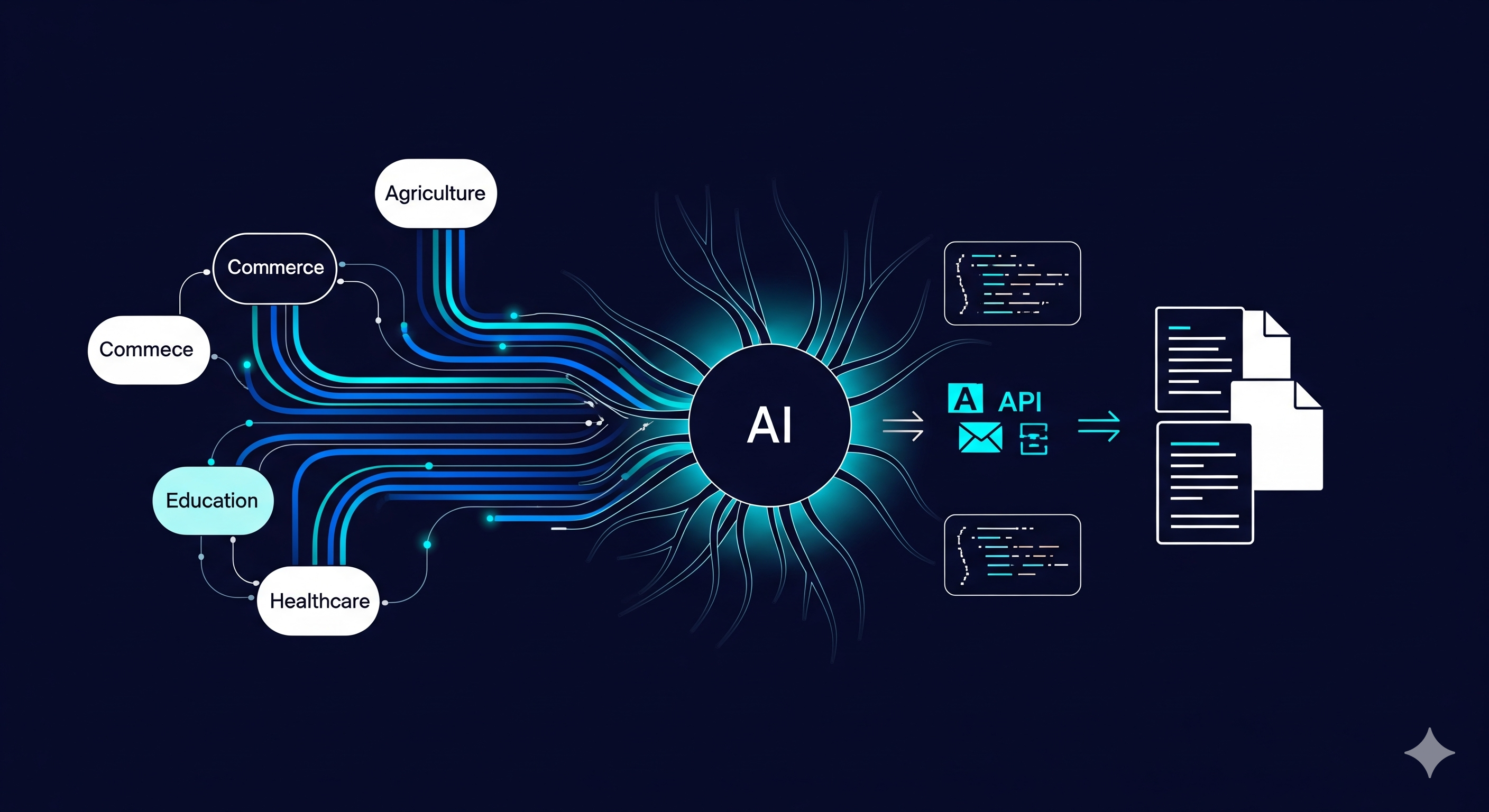
The Beckn protocol promises seamless interoperability across digital networks—from commerce and education to agriculture and healthcare. Yet despite its potential to democratize access to open ecosystems, onboarding complexity has remained a critical barrier. Traditional integration approaches require weeks of custom development, deep technical expertise, and extensive manual configuration of complex API mappings.
At Tekdi, we recognized this wasn't just a technical challenge—it was preventing the very openness Beckn was designed to enable. Drawing from our extensive cross-domain experience with networks like ONDC, ONEST, Vistaar, and UBI, we took an AI-first approach to fundamentally reimagine protocol integration. The result: an intelligent system that transforms 40+ hour integration processes into 4-6 hour automated workflows, democratizing access to Beckn networks through AI-powered configuration generation.
Beckn and the Open Network Vision
The Beckn protocol has become the foundation for building open digital networks that work seamlessly across domains. Already in use across a wide range of domains including mobility, agriculture, education, healthcare, retail, logistics, finance, public services, and many more, Beckn provides a universal language for interoperability.
At its core, Beckn defines a set of standardized APIs (search, select, init, confirm, and others) that allow providers and platforms to interact in a plug-and-play fashion. This flexibility makes it an attractive choice for anyone looking to build or participate in open ecosystems.
The Challenge: Complexity Blocking Access
Despite its promise, onboarding into a Beckn network has traditionally been hard. Providers often had to:
- Write custom scripts for every single API, starting with search
- Spend weeks understanding specifications and adapting them to their own systems
- Manage transaction flows, data mappings, and responses manually
- Navigate complex JSON configurations with intricate JSONPath mappings
- Continuously update code as use cases and standards evolved
This high barrier meant long onboarding times, heavy development effort, and slower adoption. What should have been an open, accessible network remained limited to organizations with substantial technical resources and time. The complexity wasn't just a technical challenge—it was preventing the very openness that Beckn was designed to enable.
Our Solution: AI-Native Protocol Integration
We set out to reimagine the onboarding process by thinking AI-first about a problem that was previously considered too complex for automation. Rather than just simplifying existing workflows, we leveraged AI agents to fundamentally transform how protocol integration works.
The result is a dual innovation:
- A config-driven engine that eliminates coding effort for Beckn integration
- AI-powered usecase generation that automates the creation of these configurations
AI-Enabled Democratization: How It Works
1. AI-Powered Usecase Generation
Instead of manually crafting complex JSON configuration files, providers now simply provide:
- API details (endpoints, authentication, request/response structures)
- Usecase requirements (field mappings, data transformations, Beckn schema compliance)
Our AI-powered MCP (Model Context Protocol) server—built using Anthropic's MCP framework and customized for Beckn—analyzes this information and automatically generates complete usecase JSON files that include:
- Proper JSONPath mappings
- Transform functions
- Authentication handling
- GPS coordinate parsing
- Beckn-compliant response structures
2. AI-Assisted Engine Development
The development of the engine itself was significantly accelerated through AI collaboration. AI agents contributed to:
- Debugging complex integration issues like schema validation errors and API request body generation problems
- Implementing sophisticated data transformation logic that handles diverse API patterns
- Creating comprehensive documentation with line-by-line explanations of complex configurations
- Building robust template systems that handle various API patterns (GET vs POST, simple vs complex request bodies, different authentication methods)
This iterative AI-driven problem-solving process transforms what was previously a manual, error-prone workflow requiring deep technical expertise into a streamlined, automated system that handles extensive scenarios for both GET and POST APIs.
Real-World Validation: Cross-Domain Beckn Expertise at Scale
This AI-powered approach emerges from Tekdi's deep, cross-domain experience with Beckn-based networks spanning multiple sectors and use cases. Our work across established networks like ONDC (Digital Commerce), ONEST (Employment & Skilling), Vistaar & UKI (Agricultural Networks), and UBI (Unified Benefits Architecture) has given us unique insights into the diverse patterns and requirements across different domains.
We're also actively engaged with emerging networks including Open Networks for Travel, Health, Giving & Culture, and specialized Networks for People with Disabilities—each presenting distinct integration challenges and data structures.
Recent deployments showcase this versatility:
ONEST Network: Seamless AI-generated integrations for both scholarships and jobs discovery, demonstrating the system's ability to handle different data structures within the same network while maintaining education sector compliance requirements.
Vistaar (Agriculture): Successfully deployed AI-generated configurations for weather data and crop price discovery, proving the approach works beyond digital services into physical commodity markets with location-based data requirements.
This breadth of domain experience directly informed the AI system's design—our Beckn MCP Server incorporates patterns and edge cases discovered across multiple live networks, making it robust enough to handle the diverse requirements that emerge when protocols meet real-world complexity across different sectors.
Quantifiable Impact: From Weeks to Hours
The transformation is measurable: Onboarding time has dropped from 32-48 hours to just 4-6 hours—an 85% reduction that changes protocol adoption from weeks-long commitments to same-day possibilities.
This isn't just about speed—it's about accessibility. Organizations that couldn't previously justify the technical investment can now participate in open networks, expanding the ecosystem exponentially.
AI-First Transformation: The Bigger Picture
This project exemplifies Tekdi's transformation into an AI-native organization. We're leveraging our 20 years of experience, IP, and open-source reusable code as assets to reinvent and reimagine what we can create—while maintaining a beginner's mindset toward the "how."
We're thinking bigger, aiming higher, and fundamentally rethinking first principles of how complex technical challenges can be solved when AI becomes the primary lens for innovation rather than an add-on feature.
What's Next: Complete AI-Powered Transaction Flow
We're not stopping at discovery APIs. The upcoming release will extend the same AI-powered approach to all transaction APIs (select, init, confirm, status, and more), creating a true end-to-end AI-assisted onboarding solution.
Comprehensive regression testing is underway to ensure the AI-generated configurations maintain reliability, scalability, and plug-and-play safety across the expanded scope.
Final Thoughts: Catalyzing Through AI Innovation
Beckn's vision spans multiple domains and ecosystems. Our AI-powered engine doesn't just remove technical barriers—it democratizes access to complex protocol integration by making sophisticated technical capabilities available to anyone who can describe their requirements.
By creating AI-driven tools that work for the many rather than the few, we're not just solving individual integration challenges—we're catalyzing the broader transformation that open networks promise. When AI can bridge the gap between business requirements and technical implementation, entire ecosystems can emerge that simply weren't economically viable before.
The measure of our success isn't just faster onboarding—it's the networks that can now exist because AI made participation practical for everyone.
This represents more than efficiency gains; it's AI-enabled democratization of complex integrations—pioneering a new paradigm for protocol adoption that transforms consulting from manual expertise to AI-augmented capability distribution.
Stay tuned—this is just the beginning of what becomes possible when we think AI-first about traditionally complex problems.
Interested in learning how our AI-powered approach could accelerate your Beckn network participation? Connect with our team to explore implementation possibilities.


