Over 1 crore registered learners. More than 1 crore verified identities. One profile for every one of them.
Behind those numbers is a problem most learners never see. Every action they take on a national skilling platform touches several systems at once: registering, verifying their identity, enrolling in a course, receiving a certificate, applying for an apprenticeship. Each step pulls data from one place and writes it to another.
At Tekdi, our core purpose is to catalyze societal transformation by empowering organizations with technology. On a national skilling platform in India, that meant building the part nobody sees: the middleware and backend integration layer that keeps all of it working together.
The Challenge: One Learner, Many Systems
India's skilling ecosystem runs across many schemes, training providers, assessment bodies and government systems. Each has its own data, its own rules and its own way of doing things.
A single learner might:
- Register and verify their identity through national eKYC
- Enrol in a skilling scheme or an apprenticeship programme
- Attend virtual sessions, counselling or mentoring
- Earn a certificate and pull documents from the national digital document wallet
- Search for jobs, courses and training centres
For the learner, this has to feel like one platform. Behind the scenes, it is many moving parts. If a profile changes in one place and not another, trust breaks. If one slow system holds up the rest, the experience breaks.
And all of this has to work for over a crore people.
The Solution: An Integration Backbone Built on Open Source
We built the platform's middleware as an integration and adapter layer. It sits between the platform's applications, its core services, external government systems and the learner registry.
At its heart is a learner registry built on Sunbird RC, the open-source Registry and Credentials DPG, supported by Keycloak for identity and access management. Every learner has one profile, and the registry is the single source of truth for it.
Around the registry, our middleware handles:
- API orchestration: routing each request to the right service and system
- Data transformation: translating between the formats each system understands
- Profile operations: creating, importing and synchronizing learner profiles
- Notifications: email, SMS, WhatsApp and push
- Certificates: generation with QR codes, PDF rendering and retrieval
The platform's applications don't need to know how each external system works. They talk to one layer, and that layer does the rest.
Built for National Scale
Not everything needs to happen the moment a learner clicks a button.
Profile updates, profile-photo updates and skill-card generation run as deferred operations through Kafka. The learner gets an immediate response, and the heavy lifting happens in the background.
When something fails, it doesn't vanish. Operations are retried automatically, and anything that still fails is set aside in a dead-letter queue for review. At this scale, even a small failure rate means a lot of people, so nothing can be allowed to disappear quietly.
The Impact: Register Once, Carry It Everywhere
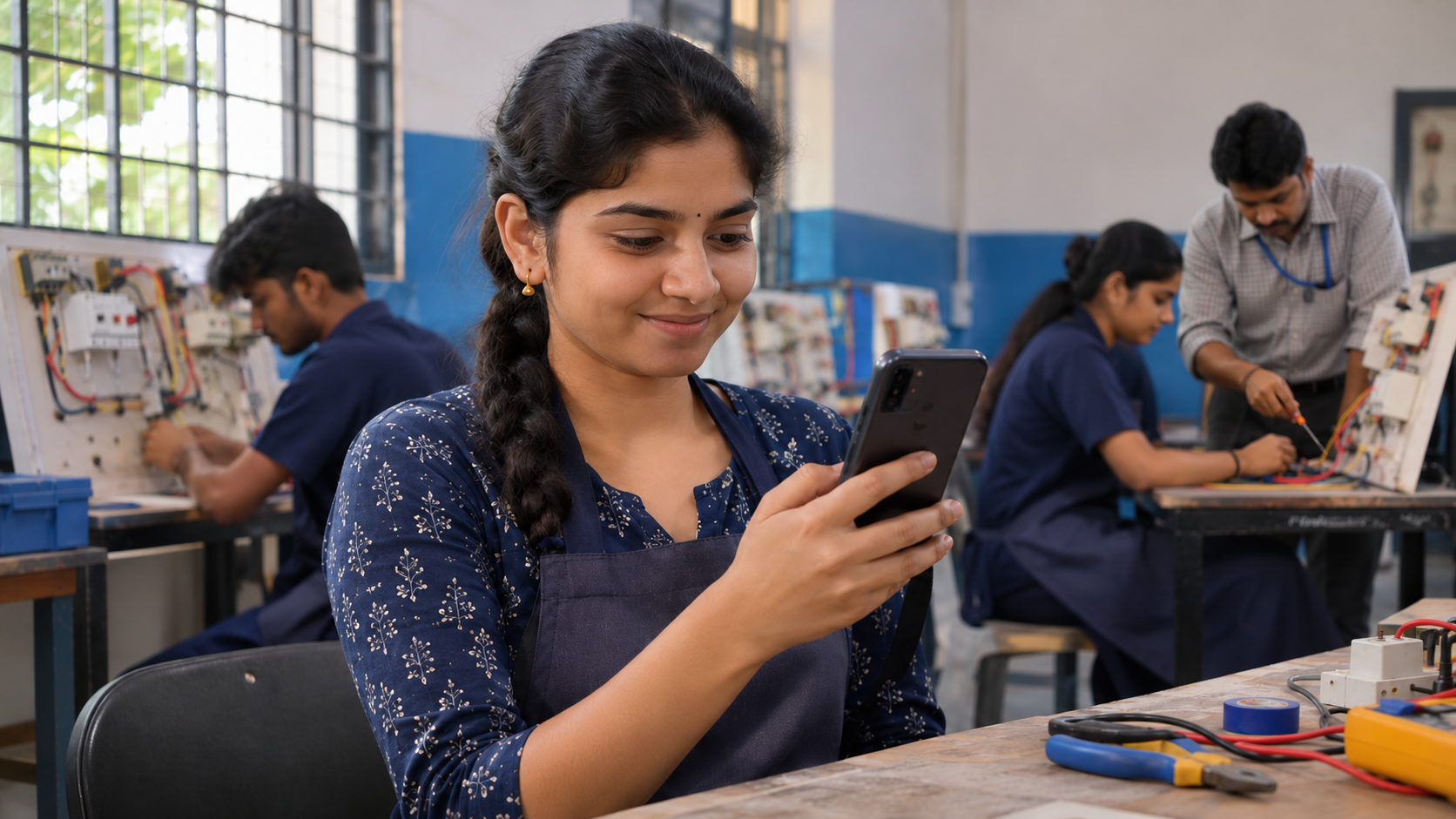
For learners, the journey is simple: explore, register, enrol, complete, get certified and apply for jobs, with verified credentials they can share along the way.
- Over 1 crore registered learners on the platform
- 1 crore+ eKYC-verified identities
- One profile per learner, kept in sync across schemes and services
- Certificates that can be verified through a QR code and shared with employers
For the agency, a single integration layer means new schemes, partners and government systems connect through one layer, instead of needing a one-off integration each time.
Building the Tekdi Way
Build for most, not for few. A platform used by over a crore learners has to work for every one of them, whichever scheme, language or device they come through.
Sustainable open source. By building the registry on Sunbird RC, an open digital public good, the platform stands on a foundation that other programmes and countries can reuse, rather than a closed, one-off system.
Reflection
Most learners will never know the middleware exists. They will register, find a course, earn a certificate and move on.
That is exactly how it should be. The best infrastructure is the kind nobody has to think about, so learners can focus on what they came for: a skill, a certificate and a better job.
Read the full case study: here


