
How expert personas, deep context, and committed human collaboration transformed focused planning time into our most powerful leadership outbound yet
After 21 months of Leadership LaunchPad training, our 30 leaders knew the frameworks. September's challenge: turn theory into behavior change through an experiential outbound.
The Strategic Choice
We could have started planning our September 14th outbound weeks in advance. Instead, we made a deliberate decision: test whether AI-Native planning could produce superior results in significantly less time.
We had specific requirements: 30 leaders, months of targeted training content to build on, and activities that would resonate with engineering mindsets. The traditional path would give us adapted generic exercises. We wanted precision-designed activities for our exact context.
September 12th, 3:47 PM: We gave ourselves one focused evening to find out if AI-Native planning could deliver what traditional methods couldn't—better customization, faster execution, lower cost.
The Design Process: What Actually Happened
Most people use AI like a search engine: ask a question, get an answer, use it. That's AI-Assisted. AI-Native is fundamentally different—it's treating AI as a thinking partner that deserves the same depth of context you'd give a senior consultant. We've explored this distinction in depth in our earlier work on moving from instructions to co-creation with AI.
The core principle: the quality of what AI produces is directly proportional to the quality of human thinking you bring to the partnership.
Step 1: Building Context, Not Asking Questions
The first hour wasn't spent asking AI for activities. It was spent building the world AI needed to think within.
After testing ChatGPT, Gemini, and Copilot, we chose Claude for its ability to hold complex context and generate intelligent counter-questions.
We fed Claude everything: Our complete training deck covering 21 months of content. Every topic we'd covered—empathy, trust culture, leader as brand, situational leadership. Company values. The participant profile: 30 leaders, 4-16 years of experience, engineers who'd see through superficial exercises instantly.
Then we described the exact gap: Leaders who know delegation theory but don't trust enough to actually delegate. Who understand empathy conceptually but haven't felt what their teams feel. Who can recite situational leadership but can't diagnose competence versus commitment in real-time.
Step 2: Creating Expert Personas, Not Generic AI
Instead of one AI assistant, we built an expert panel with specialized roles: an Experiential Learning Designer who understood adult learning theory, an Organizational Psychologist grounded in behavioral science, a Leadership Development Specialist versed in Situational Leadership frameworks, a Culture Consultant ensuring alignment with Tekdi's values, and an Outdoor Activity Facilitator who knew what works in real conditions.
We gave these personas the complete context to think like they were already part of our organization. They knew our training history. They understood our engineering culture. They could reference specific frameworks we'd already taught.
Step 3: Inviting AI to Challenge Us
We enabled counter-questioning: "If anything is unclear, push back. Challenge our assumptions."
Claude responded: "You mentioned participants know the frameworks but haven't felt them.' Can you give me a specific example of theoretical knowledge that isn't translating to practice?"
We answered. Claude adjusted. When we said, "Our engineers will dissect surface-level prompts instantly, make it more rigorous," Claude deepened the cognitive complexity without losing the emotional core.
Step 4: The Committed Human in the Loop
AI-Native demands deep human engagement. Our co-founders didn't delegate to AI—they sat with Claude, iterating in real-time, pushing each suggestion deeper. When Claude proposed an activity, they'd ask: "How does this connect to the situational leadership model we taught in July?"
AI amplifies what you bring. Shallow input produces shallow output. Deep thinking produces work neither could create alone.
What AI-Native Planning Delivered
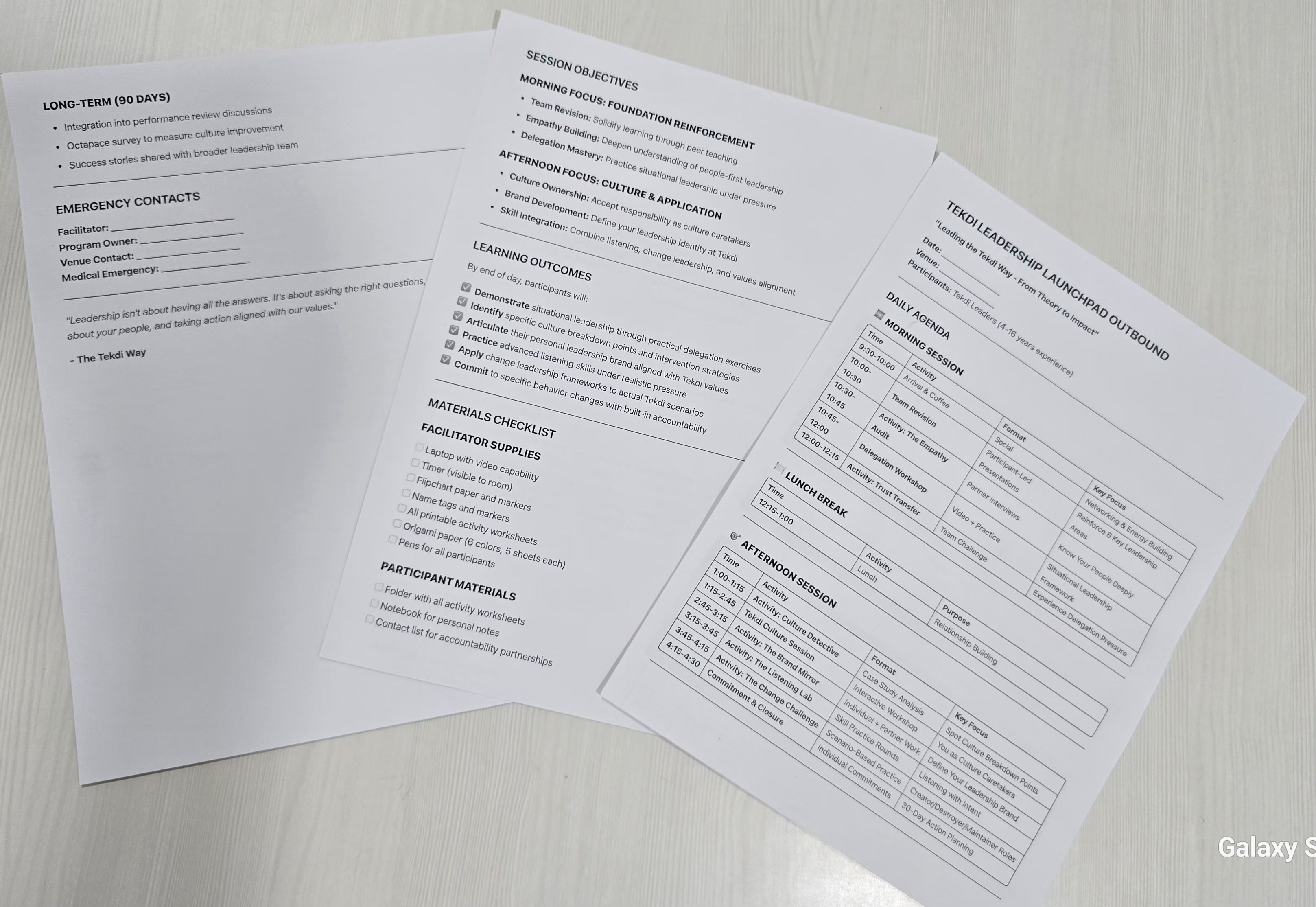
After focused collaboration, we had seven fully designed activities, each precision-engineered for our context:
Paper crane delegation exercise exposing trust blind spots in real-time. Communication breakdown scenarios forcing leaders to experience miscommunication like their teams do. Situational leadership diagnosis challenges requiring real-time assessment under pressure.
Beyond activities: Complete facilitator scripts. Timing breakdowns accounting for energy curves and weather. Debrief frameworks connecting each activity to specific leadership principles we'd taught. Observer scorecards for structured peer feedback. Printable assets ready for execution. Backup plans for contingencies.
These weren't generic team-building exercises. They were architecturally designed to surface the exact gaps between knowing and doing that we'd identified in our training.
Traditional vs. AI-Native: The Real Difference
Traditional Planning: Weeks of fragmented coordination. Multiple vendor meetings. External consultants reviewing standard packages. Generic activities adapted to fit. Significant cost. Fragmented ownership across parties.
AI-Native Planning: Focused collaboration window. Immediate iteration in real-time. Internal expertise amplified by AI capabilities. Custom-designed activities built from first principles. Minimal cost, maximum contextual fit. Clear ownership, deep customization.
The difference isn't just efficiency. It's that AI-Native enabled us to create something we literally couldn't have built any other way—activities that connected perfectly to 21 months of specific training content, designed for our specific culture, refined through expert perspectives we'd never be able to assemble in one room.
September 14th: The Real Test
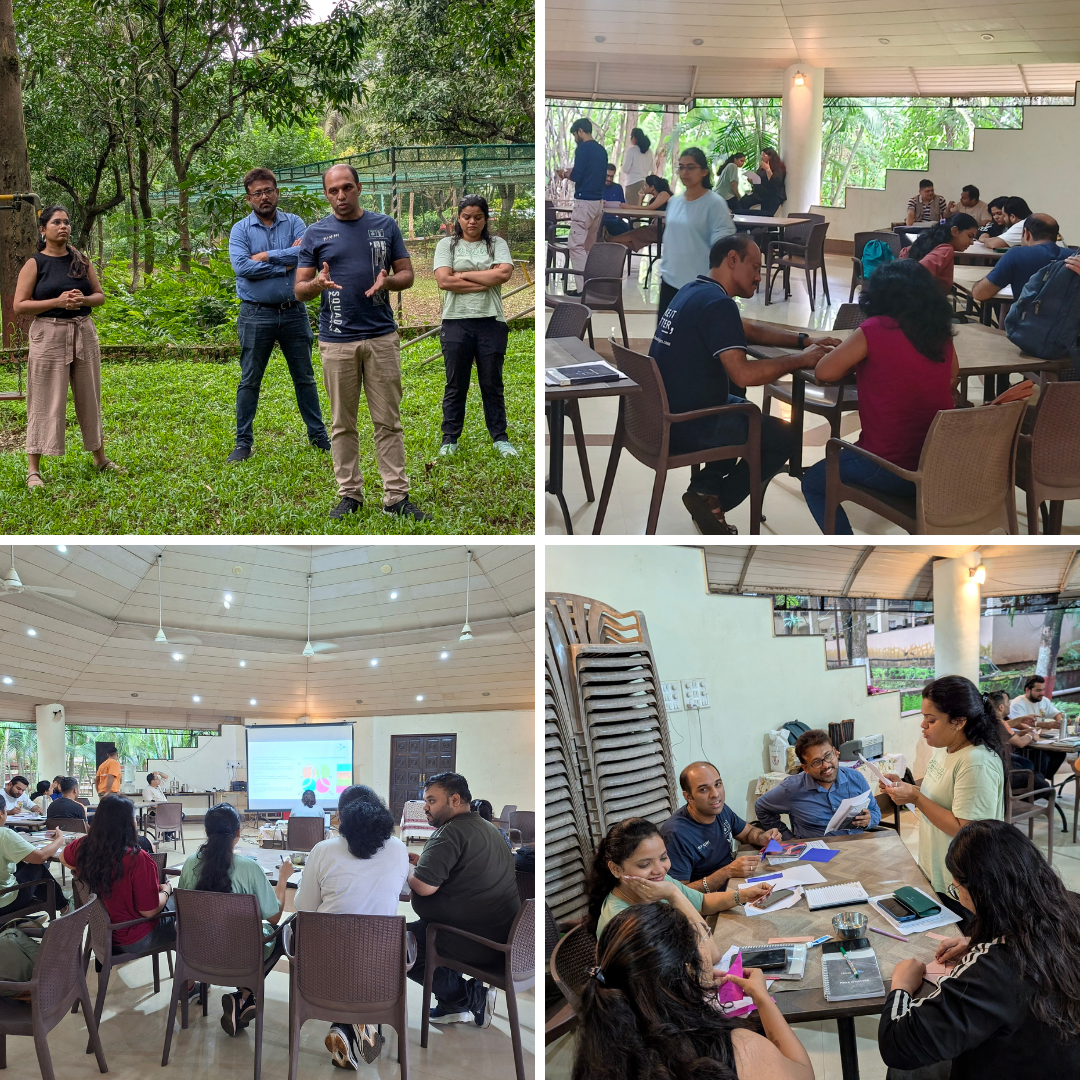
At Shantivan Picnics, paper cranes became trust lessons. Communication breakdowns became empathy training. Situational leadership moved from concept to muscle memory.
One senior leader struggled to delegate a simple origami task, then realized: "This is exactly what I do to my team. I think I'm helping by jumping in, but I'm actually telling them I don't trust them."
Another experienced what unclear instructions feel like when stakes are high: "I do this every week. I assume context is obvious because it's obvious to me. I never ask what my team member is actually hearing."
These weren't theoretical insights. They were visceral realizations from feeling, not knowing.
Did It Work?
The real test of any leadership development isn't what happens during the session—it's what happens after.
Did the paper crane delegation exercise actually change how our leaders trust their teams on Monday morning? Did experiencing communication breakdown firsthand make them more patient when explaining requirements? Did situational leadership become muscle memory, or just another framework they understand but don't apply?
Part 3 will give you the answer. We're tracking specific behavioral shifts, gathering team feedback, and measuring whether September 14th actually changed how people lead when pressure hits and deadlines loom.
Because the ultimate measure of AI-Native design isn't the elegance of the process. It's whether the thing we built works when it matters.
Your Turn
What's your experience going AI-Native? Have you moved beyond using AI as a tool to treating it as a thinking partner that demands your best intellectual engagement?
Connect with me on LinkedIn to share your AI-Native journey and get notified when Part 3 drops—where we find out if Leadership LaunchPad actually transformed how our leaders lead.


