

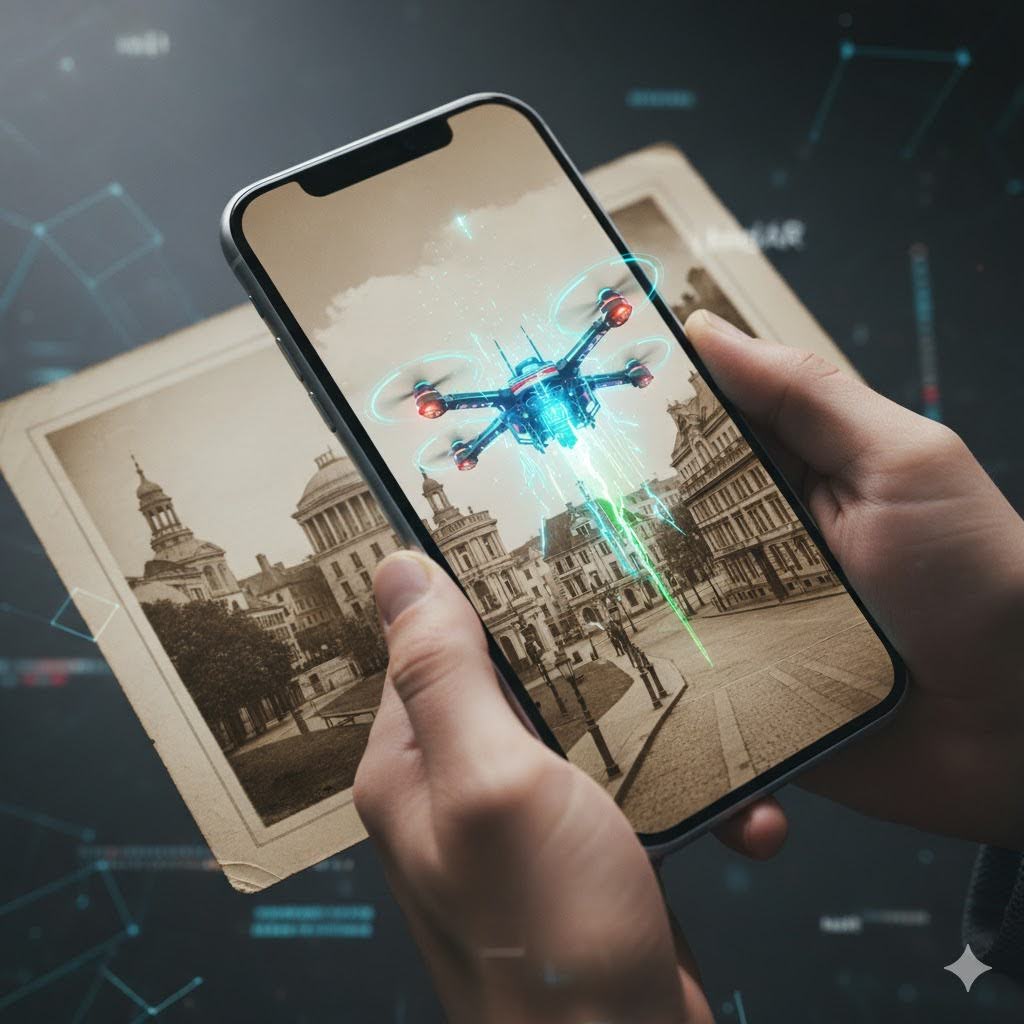
Imagine users spending 50% more time engaging with your most valuable digital artifacts and images. For businesses that showcase visual content, the challenge is getting past the static image and delivering a truly memorable, context-rich experience. We recognized a clear need to elevate our client offerings and introduce a definitive "WOW factor" that would make us stand out in a crowded market.
The Limitation of Static Visuals
While the primary business thrives on presenting rich historical and artistic content, a significant hurdle emerged in how this content was experienced. Traditional methods, though valuable, inherently limit engagement. Static images in books, framed descriptions next to artifacts, or even basic digital galleries, often fail to convey the full depth, context, and dynamic story behind each piece. The sheer volume of information, coupled with the intricate narratives of many artifacts, meant that viewers often only scratched the surface.
This limitation was particularly pronounced for our client, who not only manages extensive digital archives but also conducts frequent offline exhibitions of paintings, sculptures, and artifacts. In these physical settings, visitors are often left wanting more than just a wall plaque. The desire to delve deeper, understand provenance, explore related works, or even see how a piece might have originally been used, often goes unfulfilled. This made the search for a solution that could bridge the gap between static presentation and dynamic, interactive storytelling a very compelling and urgent need.
Web-Based AR to the Rescue
This prompted us to look beyond conventional methods and explore the power of Augmented Reality (AR). During a recent internal Hackathon, we tackled this exact challenge head-on: making any image on the web come alive with digital overlays.
Our Goal: Use AR to overlay multimedia content (like videos, animations, or 3D models) directly onto a physical or digital image target, instantly transforming the viewer's experience.
Implementation Details: Choosing and Using MindAR
To meet the need for a web-based, lightweight, and fast solution, we made it a point to choose MindAR. While we briefly considered heavier platforms like 8thWall, MindAR struck the perfect balance for our rapid prototype, proving that high-impact AR doesn't require complex native development.
Why MindAR?
- 🌐 Web-Based: It runs entirely in the browser using WebXR and WebGL, meaning zero app downloads for the end-user. This dramatically improves accessibility and adoption.
- ⚡ Lightweight & Fast: The setup is simple—a few JavaScript scripts and an index.html file—perfect for quick implementation and high performance, even on mobile devices.
The Process: We used MindAR's image tracking capabilities to automatically detect a target image. Once detected, the framework triggers a video to load and play directly on top of the image in real-time. We even overcame a version compatibility hiccup by leveraging community knowledge (Stack Overflow) to find a stable release.
For added interactivity, and since direct click support wasn't documented, we handled it manually using custom JavaScript to toggle the video's play/pause state—a small but critical step that added a layer of control for the user.
Results & Benefits:
The result was a powerful, no-install demo that validates a new dimension of engagement for our clients.
This approach has directly improved our capability to deliver:
- Competitive Edge: It provides an immediate "WOW factor," making our client's visual content unforgettable and offering a clear differentiator against competitors who rely on static galleries.
- Enriched Storytelling: It allows us to layer complex cultural, historical, or creative context onto artifacts.
🔥 Want to see the live demo? You can try it yourself right now on your mobile:
- Open the demo link using the QR code provided

- Allow camera access.
- Point the camera at the Target Image provided below.

- Watch the video instantly, load and play on the image!
Future Outlook
The possibilities unlocked by this AR-driven knowledge overlay are vast and exciting, extending far beyond the initial implementation. Imagine the transformation of cultural experiences and educational outreach:
- Enriched Exhibitions: Consider an exhibition featuring the iconic works of M.F. Husain. A visitor could point their smartphone at one of Husain's powerful paintings of horses. Instantly, an AR overlay would appear, providing access to a rich knowledge base about the heritage of his "Horses" series, the symbolism and meaning embedded in these recurring motifs, and a gallery showcasing all his significant works depicting horses, even those not present in the current exhibition. This transforms a passive viewing into an interactive exploration.
- Interactive Historical Sites: Visitors to ancient ruins or historical landmarks could use their devices to see reconstructions of what buildings once looked like, witness historical events unfold virtually in their actual locations, or access detailed information about the lives of people who inhabited these spaces.
- Educational Revolution: Textbooks could come alive. Students studying history or art could scan images to unlock 3D models of artifacts, watch historical reenactments, or hear expert commentary, making learning an immersive and unforgettable experience.
- Community Co-creation: The platform could evolve to allow communities to contribute their own stories, photos, and interpretations linked to historical objects or local landmarks, fostering a richer, more diverse narrative. This could involve user-generated content becoming part of the AR overlay, subject to curation.
This vision transforms every static object into a gateway to a universe of interconnected knowledge, fostering a deeper understanding and appreciation of our shared heritage.


