

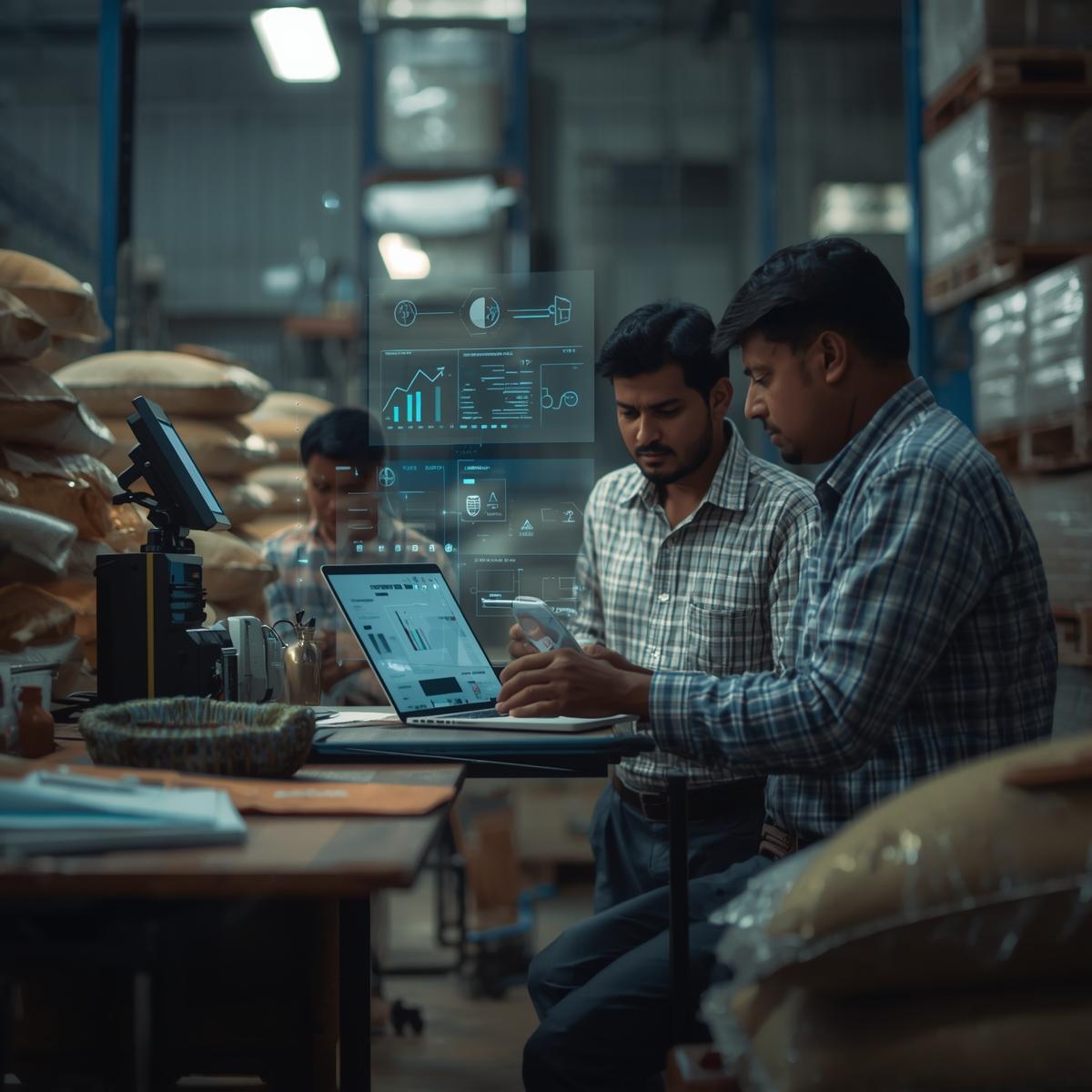
Agricultural operations in India, particularly warehouse management, are central to the economy. Yet, many are still battling a blizzard of paperwork: WhatsApp messages, endless Excel sheets, and manual calculations for rent, inward goods, and Tally exports.
Our challenge was clear: Replace the chaos with one intelligent system for the Warehouse. The solution we designed wasn't just about faster data entry; it was about achieving enterprise-grade control and transparency without relying on massive, specialised coding teams.
The Challenge: Complexity Hidden in Manual Workflows
A modern agricultural warehouse system is deceptively complex. On a day-to-day basis, it must handle multiple inward and outward transactions, track different commodities, manage warehouse occupancy, and maintain accurate financial records for rent and settlements.
Before this project, most of these activities were handled manually using spreadsheets, registers, and informal communication channels. The most common challenges observed were:
- Rate and quantity mismatches during inward entries
- Missing or delayed linkage between inward records and Sauda
- Manual calculation differences discovered at month-end
- Duplicate or re-entered data during reconciliation
While there were no formal audit failures, audits and reconciliations were time-consuming and heavily dependent on manual verification, increasing operational risk as transaction volumes grew.
Core financial tasks such as monthly rent calculation and reporting alone typically consumed 4–6 hours per week, especially during month-end. Inward entries, a frequent daily activity, took 3–4 minutes per transaction and often led to downstream reconciliation effort due to data inconsistencies.
The objective was not just to digitize these steps, but to eliminate classes of manual errors by enforcing business rules directly within the system.
The Solution Approach: Frappe + AI (A Product-First Mindset)
When selecting a platform, we weighed the trade-offs. We chose the Frappe Framework. It felt like LEGO for business systems. The low-code DocType builder, permissions, workflows, and built-in reporting engine allowed us to complete 80% of the platform using drag-and-drop tools alone.
This rapid construction aligned perfectly with our belief in the "Product First" approach, focusing on reusable, foundational blocks first. Frappe offered a good balance of structure, flexibility, and speed for a workflow-heavy, ERP-style system, which fit our use case well.
AI: The Virtual Architect for the Remaining 20%
While Frappe’s low-code capabilities helped us build nearly 80% of the system using drag-and-drop constructs, the remaining 20% involved domain-specific business logic, automation, and validations that traditionally require experienced backend development.
This is where AI made a significant difference.
Instead of manually researching APIs, patterns, and edge cases, we described our business requirements in plain language. AI assisted by:
- Generating server and client scripts
- Implementing auto-calculation and validation logic
- Defining event-driven workflows
- Assisting with scheduled background jobs
- Supporting bank and Tally-compatible export logic
What would typically take several days to a week of manual coding and debugging was often reduced to hours or a couple of days, primarily due to faster iteration and reduced trial-and-error.
AI-generated code still required review and minor adjustments, but in most cases it was functionally correct and aligned with Frappe’s design patterns, significantly lowering development friction.
We used ChatGPT, Claude, Cursor as the AI assistant for code generation, logic validation, and implementation guidance.
Early iterations of core DocTypes and workflows acted as a natural proof-of-concept, giving us confidence that the majority of requirements could be addressed using Frappe’s low-code approach. Without AI assistance, the scripting and customization effort would likely have increased from ~20% to 40–50%, along with longer development cycles.
Concrete Example: Automating Rent Calculation
A representative example is the Warehouse Rent Manager. Rent calculation depends on multiple variables — commodity type, storage duration, godown allocation, and customer-specific agreements.
AI assisted in generating:
- Server-side logic for commodity-wise/Bag-wise, date-based rent calculation
- Validation rules to prevent edits after approval
- Supporting logic to ensure consistency across records
This allowed us to implement complex financial rules accurately and quickly, while keeping the code readable and maintainable.
Real Modules, Real Impact
The platform represents end-to-end operational workflows, not just CRUD screens.
Inward (Purchase)
Handles commodity receiving, quality checks, automated rate calculations, and Sauda linkage.
Inward entry time was reduced from 3–4 minutes to under a minute for standard cases, with validations handled automatically, significantly reducing reconciliation effort.
Outward (Sales)
Manages dispatch planning, loading slips, billing workflows, and shortage tracking.
System-enforced validations ensure that every outward transaction is consistent and traceable.
Warehouse Rent Manager
Tracks commodity-wise occupancy and automatically calculates rent using AI-assisted logic. This eliminated ~4–6 hours per week of manual, error-prone rent sheet preparation and improved month-end accuracy.
Tally-Compatible Exports
Generates accounting-ready ledger and voucher formats.
By handling data mapping, cleansing, and structuring at the system level, it removed hours of repetitive manual work during accounting cycles.
Overall, system-level validations significantly reduced common manual errors such as rate mismatches, missing linkages, and reconciliation discrepancies, improving confidence in operational and financial data.
Final Thought: The Future of Software Development
The Warehouse project is our success story. It taught us a powerful lesson: Low-code removes UI complexity. AI removes coding complexity.
This project demonstrates a practical development approach that worked well for us:
- 80% built with drag-and-drop tools
- 20% built with AI-generated logic
- 100% confidence in the result
Modern development is no longer limited by coding knowledge, but guided by domain understanding and the ability to effectively collaborate with AI. The future of building software is smarter, faster, and finally accessible to more product thinkers.


